
Tuesday, June 25, 2013
Interviews from The Lilypad 6/21/13
The show at the Lilypad on June 21 was a great night, and Found Sound succeeded in getting an interview with each band. The videos are in the order that the groups performed: Jules Vincent, Closer Than We Appear, Kevin King, Burglary Years, and Saintseneca. Special thanks to Justin Healy who volunteered to be my camera man, and Owen Bolas for letting me borrow his equipment and editing the interviews into videos.

Friday, June 21, 2013
Track Review: "Reprieve"

Artist: Jules Vincent
Release Date: January 25, 2013
Label: Independent
Note: This review is part of a series of single reviews by Ryan coming out this week leading up to a show on Friday June 21 at the Lilypad in Cambridge, MA, which will feature performances by all the bands reviewed.
Jules Vincent is a young band from Beverly, MA consisting of - full disclosure - good friends of mine and fellow staff writers of Found Sound. That being said, “Reprieve” is an ambitious cut. The live version clocks in at 9 minutes and includes several distinct sections. Realistically, it could be three different songs. The band keeps the track from growing stale by introducing new musical themes throughout, as well as exploring an enormous emotive range, full of peaks and valleys.
Though the instrumentation may be the most palpable element of the song, the lyrics also deserve some attention; it’s as if the band wrote the whole work around the poetry. Mortality seems to be the preoccupation here, with the song exuding fearful sentiments of dying alone. This would be hard to gather, however, without actually studying the words. On a side note, the studio version includes samples of chirping birds that build over the song and peak as they match up with appropriately ornithological metaphors in the lyrics. This isn’t present in the live version, which is a shame. The pastoral effects adds a certain aesthetic to the piece that give the music a more profound impact.
The biggest pitfall with this song is a level of sloppiness commensurate for a band this young tackling such a complex idea. There are a few rough transitions, along with mismatched rhythms and isolated tuning issues, but most of these are lost in the length. Ultimately, the track is interesting, diverse, and demonstrates an incredible level of musicianship, particularly for a group with such burgeoning talent.
Thursday, June 20, 2013
Track Review: "Lifesaver"

Note: This review is part of a series of single reviews by Ryan coming out this week leading up to a show on Friday June 21 at the Lilypad in Cambridge, MA, which will feature performances by all the bands reviewed.
Burglary Years is a dream pop/shoegaze band from Boston. Their song “Lifesaver” is among their higher energy tracks, employing an infectious sound. The song is repetitive, which is characteristic of the genre, but uses subtle changes to keep it captivating. The lyrics deal with a breakup, or a similar situation, but the writer approaches it from a thoughtful, mature perspective. While not whiny, it is somewhat depressing. The sound itself is that of big guitar and consistent drumming, maintaining a high energy wall of sound throughout the piece. It doesn’t really go anywhere until the outro, which is beautifully done by a single guitarist using a multitude of effects. On their “about” page on Facebook they list several bands as influences, including My Bloody Valentine and The Smiths. This influence is wonderfully apparent and the band succeeds in combining different styles to create dynamic music in a genre that is often criticized for being stale. If anything, I’d like the singer to bring out a more tortured tone; he sings in a sad style but I feel like he could do more with it. The bassist could have more input as well, but it is normal for the low end to get buried under guitar in this style of music. Burglary Years undoubtedly succeeds in producing dynamic, interesting music.
Track Review: "Icicle"

Artist: Kevin King (of Maura)
Release Date: February 13, 2012
Label: Independent
Kevin King, frontman of the band Maura based out of Somerville, is doing an acoustic solo set at the Lilypad. When I contacted him, he advised me to review the song “Icicle,” as it is the best representation of the sound his performance is going to have. The song has the familiar sound of a folky singer-songwriter that conjures imagery of relaxing in a coffee shop on a rainy day. The guitar chords, repetitive as they may be, reach beyond the normal scope of this style into the region of jazz tonalities, giving the song a warm feel. The lyrics, poetic and thoughtful, seem to take the forefront, as the same melodies and chords are repeated for the majority of the song. While this works in many cases, the energy of the song is largely stagnant, with the exception of an additional voice, a beautiful soprano, late in the song. I would love to hear King put more emotion in his performance, which could be achieved by simply exploring a broader dynamic range or exaggerating the shape in his lines. Overall, the song is warm and comforting, while maintaining a certain thoughtfulness.
Tuesday, June 18, 2013
Track Review: "Mallwalker"

Artist: Saintseneca
Release Date: December 21, 2012
Label: Mama Bird Recording Co.
Saintseneca are a fairly established Columbus, Ohio based band who are playing in Boston as part of an East Coast tour. “Mallwalker” was released last December as a Christmas song, but it wouldn’t be identifiable as such if it wasn’t explicitly said on their bandcamp. The lyrics are interesting and thought-provoking, but seem more like fragmented thoughts than coherent ideas. Their sound is that of rich contemporary folk lacking, thankfully, in the pop sound that has come to dominate the genre in recent years (Mumford, The Lumineers, etc.). Instead, they employ diverse ideas into their music creating a unique, captivating sound. The closest comparison that could be made would be if Animal Collective made an album that you could put on during family dinner. But this is reliant on the sound of the guitars, the drummers use of rims, and the singer’s style more than anything else. Thick harmonies are used in the chorus, giving the music a large, communal feel that is always a great feature of folk music. This is juxtaposed masterfully with a barren interlude about two thirds of the way through the song. Aside from the disjointed lyrics mentioned before, the only criticism I could give of this song is a desire for more percussion, which takes the form of simple rim clicking during the climaxes. A more intricate style of drumming could bring the energy of this song to a different level, and would allow the low points to be exaggerated as well. The sound of Saintseneca is one of contemporary folk music, and is a wonderful balance of thoughtful and fun.
Monday, June 17, 2013
Track Review: "It's Not So Bad"

Artist: Closer Than We Appear
Release Date: May 30, 2013
Label: Independent
Note: This review is part of a series of single reviews by Ryan coming out this week leading up to a show on Friday June 21 at the Lilypad in Cambridge, MA, which will feature performances by all the bands reviewed.
Closer Than We Appear are a younger band out of Scituate, MA. Recently, they dropped two tracks on their bandcamp, including a song called “It’s Not So Bad.” The song’s sound falls somewhere on the spectrum between Death Cab for Cutie and The Dismemberment Plan, employing both a solid range of dynamics and a few different moods, all presented through a lens of tortured optimism. The title serves as the focal point of the chorus, which is repeated incessantly as if the singer is trying to convince himself of the fact. The lead guitar tone employed is gorgeous and well placed in the mix. Subtle changes presented by the guitarist keep a long song fresh, switching to a more distorted sound at the end to increase intensity. My biggest complaint is the lack of a strong bass. Its clear the bassist is a good player, and a more intricate line given a larger role in the mix could take a song like this to another level. It could probably be shorter, but the intoxicating sound lends itself to a longer form, so it’s a hard criticism to make. Overall, it’s a great track, and I definitely look forward to hearing more Closer Than We Appear in the future.
Thursday, June 13, 2013
Hurricane Poor Things

Release Date: June 10, 2013
Label: Independent
Poor Things' new EP, Hurricane Poor Things, was just released on June 10. A self-described bubblegum rock band, their sugar-coated riffs and delicately sweet vocals certainly match the label. From the opening track, "Beachcomber," they had me singing along. Their carefree aesthetic and solar-inspired riffage is highlighted from the start. Lead singer Craig Angus has a charming vocal delivery; between youthful and nasally is the only way to describe it. For however charming his vocals are, they can drift in and out of tune quite easily, which can sound ugly from time to time.
"Morgan," the second track on the EP, is easily my next summer jam. The sing-a-long vocals and forward momentum throughout the track keep the listener engaged. The wordless hook is delightful, easy to learn, and irresistible to sing with by the song's end. The back half of the track is a bit darker with some thick crunchy guitar biting through the mix. With "Morgan" being the high point of the EP, the remaining 3 tracks don't disappoint but are nothing special. Songs like "Summer Clutch" are catchy at first, but are too similar to the other, more inspired songs that with repeated listens it turns bland. Another track which falls in too close with the others is "Ice Cream." The one new idea in "Ice Cream" is a nice, toned down moment around 2:37. Granted, it only lasted only 10 seconds, but it was a dynamic that severely lacking on the other tracks.
During the EP, it always felt like there was something missing. Some extra melodic idea, some missing timbre, there needed to be something else. As a trio, it can be hard to make yourself sound big on recording and a lot of louder live acts suffer from this. Poor Things sound on record like they would be an amazing act to see live, but don't translate well on record. Messy, sunny, and sugary sweet garage rock with flairs of catchy perfection is a good way to describe Hurricane Poor Things, but then again I just couldn't have been listening loud enough.
Poor Things' new EP, Hurricane Poor Things, was just released on June 10. A self-described bubblegum rock band, their sugar-coated riffs and delicately sweet vocals certainly match the label. From the opening track, "Beachcomber," they had me singing along. Their carefree aesthetic and solar-inspired riffage is highlighted from the start. Lead singer Craig Angus has a charming vocal delivery; between youthful and nasally is the only way to describe it. For however charming his vocals are, they can drift in and out of tune quite easily, which can sound ugly from time to time.
"Morgan," the second track on the EP, is easily my next summer jam. The sing-a-long vocals and forward momentum throughout the track keep the listener engaged. The wordless hook is delightful, easy to learn, and irresistible to sing with by the song's end. The back half of the track is a bit darker with some thick crunchy guitar biting through the mix. With "Morgan" being the high point of the EP, the remaining 3 tracks don't disappoint but are nothing special. Songs like "Summer Clutch" are catchy at first, but are too similar to the other, more inspired songs that with repeated listens it turns bland. Another track which falls in too close with the others is "Ice Cream." The one new idea in "Ice Cream" is a nice, toned down moment around 2:37. Granted, it only lasted only 10 seconds, but it was a dynamic that severely lacking on the other tracks.
During the EP, it always felt like there was something missing. Some extra melodic idea, some missing timbre, there needed to be something else. As a trio, it can be hard to make yourself sound big on recording and a lot of louder live acts suffer from this. Poor Things sound on record like they would be an amazing act to see live, but don't translate well on record. Messy, sunny, and sugary sweet garage rock with flairs of catchy perfection is a good way to describe Hurricane Poor Things, but then again I just couldn't have been listening loud enough.
Thursday, May 30, 2013
It Begins

Release Date: May 7, 2013
Label: Independent
"The journey from idea to reality."
Earlier this month, Thunderboogie let their second release, It Begins, loose. Clocking in a little over 20 minutes, each of the three tracks on It Begins displays a different aspect of what the group is capable of. Kicking the album off is "The Call" with an intense speech about risking our lives today for the future, traveling towards that time, and accepting the call. We then travel to a beautiful sanctuary while in-flight with "Quarky the Galaxy Bird." Then we safely land in the grooving grounds of "Geejam," the concluding track, that climbs musically through many different zones.
A neat aspect of this album is all you are hearing was, at one point, a live take. When recording these songs, Thunderboogie would play it from top to bottom without stopping to take the best cuts. Bassist Jake Downey said the fun in recording this was seeing "which jam told the best story for each of these songs." The chosen cuts for It Begins display these excellently. For a release with only 3 songs on it, you get more of a musical satisfaction then you would anticipate. You can partially thank the trumpet for that; it always adds such a distinct sound, especially when it is the only given horn in a group.
"The Call" opens It Begins. The 5 minute 26 second Middle Eastern influenced song simply drags you into this work. Justin DiLuiso, a long time friend of Downey delivers the thesis of It Begins altogether, compact into one eerie speech pushing the point that "for the future we must risk our lives. But when we get there, all shall be created." This song brings some of the most prominent funk on the album due to dominance of the rhythm section and the bass-in-your-face style of playing, a beautiful and recurring aspect of this album. When it boils down to horns, the given lines the trumpet delivers are a bit lackluster for the track. This, though, is due to the fact that in the recordings he is not nearly loud enough comparatively to the remainder of the band.

Do you ever find those songs that, even on the first listen, strike you in a certain place? A place very solemnly touched upon musically. For an indescribable reason, you feel an urge to give it another listen, and every time you do so there is a new feature flourishing in your ears. Personally, this is what I would have to describe "Quarky the Galaxy Bird" as. Every given aspect of the song delivers to its fullest potential. This beautiful tale tells us of Quarky and his journey from Earth to Outer Space. He begins this journey shortly after he realizes that he shouldn't fight the air with his wings, but that he must reach the height where he floats harmoniously like the clouds. Every time this beautiful ballad is played, the improvised segment of the song displays Quarky's journey from Earth.
Not long after we have begun this trip through music we escalate towards the finale, "Geejam." An (almost) instrumental that spends 9 minutes and 10 seconds on a musical journey that transitions from beautiful soaring dynamic areas, to the house of what seems to be a lesser experienced spawn of Page McConnell and Ray Manzarek with piano tickles galore, to a Jimi-influenced land where the four on the floor dance party the rhythm section is throwing gets coated by echoing guitar work and bulletproof trumpet accents. What better way to end a nice musical journey then with a beautiful vocal cadence repeating itself a couple times as the band slowly pulls the song to a halt?
Look at this album as a sandwich. There are a top and a bottom bun, and delicious contents in the middle. Without the essential buns, the structure that holds the sandwich together and makes it complete, it would be a mere single that had no conversational value. A bun-less burger. When all together though, you have the entirety of the meal, buns and all. The main focus of the sandwich may be on what is in the middle, yet it would not be nearly the same without the components that made it all one piece. That is how I look at It Begins. You can find serenity in "Quarky the Galaxy Bird," but that is not to say that "The Call" and "Geejam" aren't excellent pieces. They both collectively complete the work and make it what it is at this very moment.
- Woocci
Monday, May 20, 2013
Show Review: Dads

The audience was equally, if not more, frenzied than the band; jumping, moshing, and crowd surfing galore. At one point between songs Bradley said to the audience “You guys are sick,” and it was hard to tell if he meant it or if he was just poking fun. It seemed everyone in the room was having a great time. It wasn’t all high-octane partying though. Dads’ songs also hit points with tone-downed drums and beautiful spacey guitar lines, giving the show some quieter more romantic moments. Overall it was a very energetic, communal, and strangely intimate show that was downright blast to be at. They have a great vivacity live that their recordings, unfortunately, fail to capture. I would certainly recommend seeing these guy’s in the flesh to anyone.
After the show we got the chance to do a quick interview Dads:
Here’s a bit of footage we caught from the set:
You can check out some great photo’s from the show (like the one above) taken by the folks at Future Breed here.
And here is Dads’ bandcamp page.
Friday, May 17, 2013
The Redeemer

Release Date: May 1, 2013
Label: Boom Kat
The Redeemer by Dean Blunt is an album of contrasts. Coming from the experimental pop duo Hype Williams, Blunt's third solo album comes with little fan-fair or pretense, despite still being a "pop" album. Sweeping harps, strings and orchestrated melodies dance along side hip-hop beats, eccentric samples and droning, evocative vocals from both Blunt and contributor Inga Copeland. Its the kind of instrumentation one might see in a Kanye West album, even though Blunt has said his favorite record is still What's the Story Morning Glory and that he hates hip-hop (Source)
The Redeemer by Dean Blunt is an album of contrasts. Coming from the experimental pop duo Hype Williams, Blunt's third solo album comes with little fan-fair or pretense, despite still being a "pop" album. Sweeping harps, strings and orchestrated melodies dance along side hip-hop beats, eccentric samples and droning, evocative vocals from both Blunt and contributor Inga Copeland. Its the kind of instrumentation one might see in a Kanye West album, even though Blunt has said his favorite record is still What's the Story Morning Glory and that he hates hip-hop (Source)
The whole album's production is in stark contrast to Blunt's previous work in Black is Beautiful where mid-range frequencies failed to exist and infra bass caved in speakers. The Redeemer is almost a boastful album in this respect. Genre boundaries are jumped over and over again. Walls of Jericho paddles off with wave samples and tension-filled violins, only to be succeeded with Make it Official, a sappy, guitar solo driven R&B track. Its clear Dean Blunt doesn't care if his music makes sense, often switching between synths and recordings of the same instruments between songs. Even with all the poppy experimentation, Blunt still finds room for sincerity and meaning. Raspy voicemails and crooning songs about lost love scatter a very intimidating, but not hostile, album. Despite its origins in detached, classical art made from trashy music, The Redeemer is an interesting experiment with the structure of music and of an album.
Wednesday, May 15, 2013
Track Review: "We've Always Been Here"

Release Date: June 25, 2013
Label: Beyond Beyond is Beyond Records
"Worthless is Curtis Godino, Skyler Toski and Nicole Zamfes. We make sounds for the soul. We are Worthless."
A little over a month from now, Worthless will put out another album called Keep Sleeping. At this time we only have access to the second track, "We've Always Been Here." Unlike their previous self-titled release, "We've Always Been Here" has its grasp on a far eastern influence. The lo-fi, hard to decipher vocals seem to be a common trait of the group. It gives it an eerie feel to fit in the puzzle with the desert rock progression of the song. A comfortable blend between twang and persistent fluid motion is found here, and can easily satisfy your ear. There is a soothing acoustic melody holding the song from the ground up. More complex percussive features start to add a bit of sophistication here and there. Worthless strategically uses the aspect of Start-Stop in this song to tie from one part to another smoothly and confidently. Not nearly as confident as the ending of the song though, where a multi-part harmony carries the ship to a safe docking. I look forward to seeing what the band will pull with the remainder of Keep Sleeping.
Worthless is also releasing this album in a limited edition cassette format of 100 copies. For only $8.00 you can pre-order this and also get a fold out poster with it. Items ship around the 21st of June.
Friday, May 3, 2013
10"

Artists: GIRAFFES? GIRAFFES! and Goddard
Release Date: April 30, 2013
Label: Boiler Room Records
10” is a split featuring one track from math-rock duo GIRAFFES? GIRAFFES!, and two from the genre-blending group Goddard. The first song, “In the Middle of the Night Someone Tore Off the Ceiling and Sucked Me Into the Sky / Before My Eyes Began to Boil I Saw Billions of Tiny Webs Connecting Everything” is a ten minute tour through headspaces ranging from acrobatic upbeat punk, to desolate reverb-washed riffing. At times, it seems like there were too many ideas for any one section to truly grow but, as an overall piece, the pacing was good, with satisfying transitions from foreboding to exuberance or quiet to chaos. The sheer volume of ideas and the ability of the band to transition between them with ease are impressive, but at no point is instrumental athleticism the focus. In a style that’s been known to put complexity above all else, “In The Middle of the Night” is noteworthy because GIRAFFES? GIRAFFES! use their extreme instrumental talent only to develop the track to its fullest potential.
Goddard presents an interesting mix of musical styles. They sit on the mathier side of post-punk, and two versatile vocalists help keep their songs interesting throughout. On “Midwest 95”, a light opening and sarcastically vivid lyrics take a sudden detour into a half-time jam and repetitive, building shouts. “Thrush” has a similar quality, with a dark, brooding section suddenly becoming completely undone. In both songs, there’s a lack of buildup to the more intense sections, and they feel a little awkward in context. However, the abruptness isn’t enough to take away from the atmosphere of the songs, and in some ways adds the aggressive energy. Like their partners on the split, Goddard know their ways around their instruments, and use this to flesh out far more than two tracks worth of ideas. 10” is, by its nature, a release that will be appreciated by lovers of the rhythmically complex, but it’s never bogged down by the talent of its musicians and it has a wealth of content and a high replay value that anyone will appreciate.
-Alex D'AlfonsoMake Me Stay / No More

Artist: Sander Mölder
Release Date: April 29, 2013
Label: Independent
Sander Mölder's newest single Make Me Stay / No More contains two (soul dance?) tracks featured clearly in the title.. On both tracks, Mölder displays his excellent craftsmanship and creativity when it comes to the use of vocal samples in his music. "No More" is easily the better of the two tracks, being both club-ready and having the most progression. Overall, it's the more interesting of the two tracks. Jittery percussion and choice synth tones create an instant soul-infused banger. DJs will eat this track up. Stylistically, it fluidly and successfully channels "Satin Panthers" era Hudson Mohawke. The main feature of "No More" is what sounds like some pitched up dirty talk, moaning "I need more" over and over. Most of the vocals on this track come from this one sample, but are chopped creatively (see 1:26).
This isn't to say that the first track isn't any good; but it is not something that will make it to a DJ's set, something that appears to be Mölder's end-goal. His vocal manipulation is again spot on with "Make Me Stay," it is comparable to Burial at points. The main turn off of "Make Me Stay" is that it relies on the hook too much. The song doesn't end up going anywhere, but only back to where it started. Combined with the cheesy 80s brass sounds, it can get a bit tiresome. Despite it's flaws, Make Me Stay / No More is a single worth remembering, plus, look at that album art.
Thursday, May 2, 2013
Feather Weight Soul Tape

Release Date: April 28, 2013
Label: Independent
Summer time is near and feel-good music is beginning to fill the air. You may want to lean towards the upcoming, feel-good release if you find yourself pleased with innovative genre blending. Feather Weight Soul Tape takes aspects of indie music and branches from that to dream-pop and moderately psychedelic territory. Over all of this though, the album is coated with acoustic guitar, electronic sounds similar to that of , and very on point vocals. The album sticks to a airy pop influenced style yet throws in some spice here and there, keeping it fresh and funky.
Consisting of 6 tracks, Feather Weight Soul Tape is a rather quick listen, clocking in at 19 minutes, 16 seconds. Mitchell, who recorded all the songs on this album in his basement, kicks off the album with an extremely catchy instrumental called "Purple Tide (intro)." Although under two minutes long, this opening track displays some of the most creativity on the album. From the extra-terrestrial sounding synths to the foundation that is the tight knit bass line, "Purple Tide" plays not only as an excellent starting point, but and excellent lead into the second track "Wide of the Mark." This track sees the albums first exposure of words, and they are pretty powerful ones at that (see: "and I wonder, do my good parts outweigh my faults?"). Electric guitar too can be heard for the first time on the album, complementing the main melody. If you're looking for some grooving time, this has the most to give off the entire genre-hopping album.
"Summertime," the third track on the album shows a fun side of beach pop. This track sounds a lot like something that would come out of a combination of Dion and the Belmonts and "Twistin' by the Pool" era Dire Straits. "Summertime" displays arguably the most indie sounds off the entire work, which would work a whole lot better if the lyrics didn't seem to be a jumbled up narrative with excellent harmonization. A recurring theme for this album the third track displays is the rip-chord endings when the songs just seems to fall off to an abrupt finish.
Return of the extra-terrestrial synths in the beautiful duet "Nothing Personal," the fourth track on the album in which Mitchell brings in Chloe Newnham. The wobbly lick that is used as the songs staple almost seems to have been torn from the Nintendo game Animal Crossing, it has a deliciously unique sound that you hardly ever hear. One of the strongest parts of Feather Weight Soul Tape is the recurrence of certain sounds placed in different environments. Sounds that Mitchell used as a hook in "Nothing Personal" are seen frequently on the album and strongly in the album opening track.
Following suit of the second song on the album, "Trapped in its Teeth" is a moderately upbeat ballad with heartfelt lyrics and a twangy guitar rhythm that would sit well on a Ukulele. The song tells a story of a man who is feelings stuck within where he currently is and is not satisfied with the lack of seclusion. Along with this is him trying to show his love-interest he "exists."
Continuing this tale is the album closing track "Homecoming." This song is written almost like three separate letters. Starting with Mitchell seemingly returning to his hometown after a long absence. Followed by him telling the city he loves it wasn't replaced by another, and he still loves it intently. Feather Weight Soul Tape's final track concludes with a letter of his leaving even though he still feels for the location, and he says he will return. It's a power ballad with the same looping organ pattern over again that drags on and on. For the impact that the lyrics put off, the instrumentation on the track is rather lackluster, and leads to a disappointing dead stop to the album.
Continuing this tale is the album closing track "Homecoming." This song is written almost like three separate letters. Starting with Mitchell seemingly returning to his hometown after a long absence. Followed by him telling the city he loves it wasn't replaced by another, and he still loves it intently. Feather Weight Soul Tape's final track concludes with a letter of his leaving even though he still feels for the location, and he says he will return. It's a power ballad with the same looping organ pattern over again that drags on and on. For the impact that the lyrics put off, the instrumentation on the track is rather lackluster, and leads to a disappointing dead stop to the album.
All in all, Mitchell put out a pretty mellow album for us to begin to bring in summertime with. The album covers much ground in its just short of 20 minute run time without going too far astray for the message he is trying to convey. Vocalization on the album is beautiful and an extreme highlight of the piece all together. Don't go into this expecting the next big indie-pop sensation, but more so go into it for some easy listening, floaty feeling and dreamscape creating tunes.
- Woocci
Thursday, April 25, 2013
Track Review: "Spirits"

Release Date: April 20, 2013
Label: Independent
On 4/20, The Nth Power showed us what they got with their first release Basic Minimum Skills Test. The album is available for $6 (USD) on their Bandcamp page.
Basic Minimum Skills Test kicks off with "Spirits,” beginning with a extremely airy feeling section lead by locked in South American sounding percussion before a swampy guitar lick sweeps in and carries the track onward. "Spirits” brilliantly showcases what they say the album displays: funk, jazz and soul. Throughout the track, the vocal harmonies feel as if they pick up on a distinct reggae influence. The themes in the song are constantly revisited, yet it is not overkill the overall output. The instrumentation on the album is ridiculously tight; dynamics are an extremely important part of this kind of music, and The Nth Power takes this into strong consideration with the framework of not only this track, but the rest of the album. When writing, much like in literature, there is the important "grabbing line" at the very beginning that is supposed to perk the readers interest. "Spirits" is an excellent "grabbing track" for this album, making it easier to step into the rest. Though the vocals may be overwhelming at times, there are minimal risks taken in creating this song. Lack of intense risks makes for an easier listen, and that really helps with this ear pleasing tune.
- Woocci
Monday, April 8, 2013
Space Junk

Release Date: April 2, 2013
Label: Crash Symbols
Is it summer already? No? Well, it feels as if summer's come early with Halasan Bazar's album Space Junk. Slap on some cans and let the humming organs, vintage guitar tones, and gentle harmonies sweep you off your feet. Halasan Bazar's take on the fuzzed-out west coast garage rock of the 1960's goes beyond a mere imitation of their influences.
The sunny acid-soaked Beatles-esque compositions on Space Junk are, for the most part, pleasant. Tracks like "You and I" wallow in the psychedelic mood that the group is so great at creating. LSD-laced vocals dominate the track for the most part but are accompanied by a circling instrumental. The song is a great example of what Halasan Bazar is going for on Space Junk. The entire album feels nostalgic, as if the band is trying to pull us back into the 1960's where we'll all just hang out for a while.
Lyrically the album is quite a different story. While the instrumentals are relaxed and friendly the lyrics are desperate at times. On "Live Without Love" Mr. Halasan instructs us to "Live without love, die without love." "Stay," other than sounding like a drug-riddled Route 66, is a grasp for a comforting presence, vocally crying "Won't you stay?"
"Stay" seems to be a prelude to "The Light of My Day," arguably the album's strongest song. Starting off quaint, frail, and fragile, the gentle acoustic guitar and hushed vocals quickly gain confidence. Here Halasan Bazar plays with a less psychedelic sound, going for something more at home and earnest. Eventually incorporating other instrumentation (including harmonica, which isn't seen anywhere else on the album) the song slowly builds itself to awesome proportions. At it's height, the vocals scream "Hold me close, say you'll stay. please hold me tight, then you'll stay. Oh, you light my day, keep me blind, lead the way." There's something amazingly uplifting but tragic in the juxtaposition between the desperate vocals and the awe-inspiring instrumental.
There are certainly moments of nostalgic brilliance on Space Junk, (namely "How Did We Get Here in the First Place" and "The Light of My Day"), but there are still a few gripes I have when listening to this album. Mr. Halasan's straining vocals are quite nice, but aren't for everyone and this may be an immediate turn-off for some. Some tracks rely on the same riff or main melody for too long. Without any new material or timbres, this gets quite stale.
Everything considered, Space Junk is an interesting listen. Definitely something I'd 'highly' recommend to certain people. In all seriousness, if you're looking for something to blast in your car on a road trip or just something feel good for this spring/summer pick up Space Junk, you won't regret it.
Tuesday, April 2, 2013
Theatre By The Sea

Release Date: March 26, 2013
Label: Independent
Artist Janek Gwizdala is certainly no newcomer to quality music such as found on Theatre By The Sea. This English bassist (living in the US for over a decade) has been on the international music scene for years, as a sideman or group leader. He has worked with Randy Brecker, Mike Stern, Pat Metheny, Hiram Bullock, Wayne Krantz, Peter Erskine, Airto Moreira, John Mayer and many other professional musicians. Gwizdala's maturity is reflected in the taste and crispness in which he created this album. Beside himself, there were nine musicians who contributed, some appearing on all compositions while others appearing on only a few. This album is chock-full of vigorous unison lines and interplay which holds a cognizance and ardor matched by few other modern jazz groups.
The album starts of with "Erdnase" an exotic Latin song which demonstrates one of the core themes of the album: the repeated use of enticing unison lines accompanied by a tight, interlocking rhythm section. This track gets the album rolling and sets up nicely for the next track, "España" a spacey latin tune with some deep emotion. The saxophone cries and wails, shooting nicely over the rhythm section which lays down a groove which at times feels dejected and others spirited. Straight piano interludes and spacey sax, strings, and voice build in the second half and slowly come back down. All this is done very tastefully, just as the rest of the album is.
"Portugal" is the brightest and poppiest sounding of all the tracks on this album, rising out of the ominous end of "España" like a phoenix from the ashes. Even in the poppier chord progression, a distinct Latin/jazz sound is still retained with evident folk influence. The guitar solo continues over a build of layered vocals and lively comping from the rhythm section, giving way to a smooth jammy feel in the last minute or so. "Randroid" continues with a funky jazz/hip-hop feel. The rhythm section does a great job on this track of supporting the soloists and keeping the repeated forms fresh with new palettes of various rhythms and influences, as well as building well with good timing in each section.
The longest track of the album, "Once I Knew" is very different from the others, starting with a delicate, ambient guitar intro giving way to a ballad feel. This downtempo setting stays for the rest of the song, at some points dragging on and giving a bit of a wandering feeling. Nonetheless, the rhythm section keeps it interesting and retains their distinctive style of exchange below and with the other members of the group. "Fooling Houdini" holds an interesting ambient fusion feel, which sounds as busy and locomotive as it does stagnant. There are some moments in this song that sound much like Radiohead-esque jazz. The title track "Theatre By The Sea" sounds as if I had synesthesia in a contemporary art museum, what with all the different genres that are touched upon so frequently and in such a short amount of time.
"The Goshman" holds some of the best examples of the use of unison lines and tight, interlocking background provided by the rhythm section. This track stands out the most when it comes to improvisation, for both comping and soloing. This inexorable funk/jazz song really gets your body moving all the way through to the end, where it just kinda falls off a cliff. The closing song, "Chicago Opener" pedals onward with a progressive feeling, between the unison lines lead by the drummer and piano that looms overhead like a storm. These clouds brew and accrue with added horn lines and a soaring guitar solo which all build into a wall of sound, giving way to a tight groove that rides out to the end.
This album did not have many flaws, and those that it did have were dwarfed by the sheer professionalism that radiates off of these songs. Gwizdala takes songs that are (for the most part) simple and transforms them by using different combinations of instruments to expand and decline. In addition to the great composition work, this album hosts a myriad of talented musicians, especially the drummer, who played an integral part in the progression of different sections and their levels of energy. Each player holds a distinctive voice on this album, and the way in which they spoke to each other left for some truly provocative conversation. I would have loved to hear more vocals on this album, as they provided a key addition to the first three tracks on the album that I missed in some of the later tracks. Nonetheless, this album is a breathtaking look into the mind of Janek Gwizdala and has caught a firm hold of my attention for him.
Monday, April 1, 2013
7.25.2148

Release Date: March 28, 2013
Label: Telefuture Records
7.25.2148, the new EP from electronic duo Matthew Pusti and Christian Williams, is a conceptual record that musically describes a journey through space and the future. Filled with warm droning bass and rich synths, this album produces an enjoyable ambient vibe as well as some dance-able inflections. The rise and fall of each song creates a feeling that time has stopped, and each track appears much shorter than it really is. This helps suspend reality as the listener is transported through the final frontier.
As the opening track, “An Infinite Horizon” sets the tone of the album with a reverberated arpeggiation and background noise like that of an engine room. Immediately, one is thrust into a dream-like world of ambience and serenity. A subtle droning bass slowly replaces the background noise, and more atmospheric synthesizers drone in their upper registers. The song builds, and the continued arpeggiation holds a delicate beauty like the stars of space. Many subtleties may slip past as the song slides along without commanding any attention. This being said, in the realm of ambient music, it fits in perfectly.
Following this smooth ambient track is “Quadra IV,” which continues the concept of space exploration, but includes a driving drum beat and more synths with less warmth. The song is reminiscent of the arcade game Space Invaders in the feelings of urgency and danger as one tries to survive the perils of the universe. The track slowly progresses, and would maintain the ambient style were it not for the presence of drums. Like the rest of the album, the song maintains a nice burbling bass throughout.
Arguably the most interesting track on the EP is “Versions.” Opening with avant-garde like pinging sounds, the song grows to a whining synth and thick bass below it that gives a very spooky feeling. The song continues the dominantly ambient vibe of the EP, but with less musical sense and much more atmospheric tone. Rivalling this track is the closer, “Praxis.” Holding extremely different ideas, this track has some dancier house styles while still keeping in the sci-fi theme. The entire song is not as warm as the rest of the album, and uses much higher pitched synths and more rhythmic intricacies as well as melodic lines.
This EP holds true its conceptual ideas, and really depicts futuristic space travel in all of its eerie beauty. The overall warm droning and constantly rumbling bass comes off boring on a surface level, but the detail and progression comes through upon closer inspection. The inclusion of some good ambience and danceable beats provide for enjoyable listen either in the background or with closer inspection.
Deertree
 Artist: Deertree
Release Date: April 1, 2013
Label: Independent
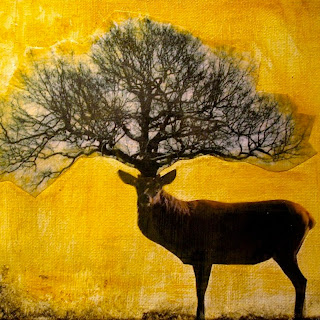
Deertree is the folk solo project of Thom Koehly, and his eponymous debut is charming; a quaint folk album that doesn't push too hard in any one direction, but rather sets a gentle and nurturing mood. Deertree tells a bleak but beautiful tale of a lost traveler and ensuing loneliness conveyed through a variety of colorful vocal harmonies and warm guitar tones. With tracks flowing from one to the next perfectly, this album feels less like a collection of individual works but rather chapters of the same novel. Along with similar lyricism, most of these songs share very similar chord progressions. Not to call the songs uninspired, but they all sound quite similar to one another (especially “Walkin I,” “Everything or Nothing,” “Jeneher: Trying to Reach the Sea,” “Barefoot Pilgrim,” and “Walkin II.”) It unifies the songs in a way that can get tiresome with repeated listens, but keeps the album feeling like one larger story..
Droning guitar playing is another factor in the similarity of these songs. Often times progressions move slow and timidly, but nonetheless precisely move from chord to chord. There a good few songs that break the mold; tracks like "The Little Boy Lost" or "Jeneher: Trying To Reach The Sea" have much more interesting features. "The Little Boy Lost," the opener, sounds straight off of Bon Iver’s For Emma, Forever Ago. This isn't to say that it’s not interesting or creative, just that it sounds extremely similar on account of the guitar playing and strong falsetto vocals. Koehly uses a large range of vocal styles on Deertree, ranging from low raspy tones on "The Morning Lights" to the enchanting harmonies in falsetto on "The Little Boy Lost” which, unfortunately, is the only track where Koehly shows off his impressively tender upper range.
Koehly's elusive lyricism brings forward themes of loneliness, loss of purpose, and hopelessness. Fantastic moments appear abruptly throughout this album. For instance, as "Everything or Nothing" bursts into a 3/4 explosion at 4:09, Koehly sings "everything was still nothing." Coming from the previous sections of the song, this is quite impactful. Another example is "The Morning Lights" where 3 or 4 part harmonies come in belting "I'm not dying! I'm not dying! The lazy day is over. I can." For all the moments where there are meaningful lyrics, there are many moments where his singing can't be understood or is just inaudible. It's either his singing or the mixing that gets in the way of hearing his lyrics, which are vital for this album's enjoyment.
The instrumentation and aesthetic, unfortunately, don't hold up amazingly after repeated listens. Koehly depends too much on mood and feeling at times, causing some tracks to get rather bland after a few listens. Instead of finding new things interesting, it becomes easier to find mistakes or unfavorable moments. The chord progression used on many tracks can become tired and the toy piano (which, granted, is used infrequently) loses it's charm after a few listens. That being said, the album is still a good listen but it doesn't hold up well under a magnifying glass.
Deertree is the story of a lost traveler unsure of where he's going or what he's doing. Everybody questions themselves during their life as to what they're doing or where they want to be. At some point in their lives, everybody misses their family, can get homesick, or gets lost altogether. Deertree relates to the scary pictures of uncertainty drawn on life's canvas. This album is going to go over well with a lot of people, I'm sure; Koehly's voice is beautiful, and his guitar playing is moody as anything. If you've ever liked anything in the new era folk-pop genre (Arcade Fire, Bon Iver, Sufjan Stevens) I recommend this album. If you don't, I wouldn't stay away but don't expect anything that'll crack your top 10 for the year.
Sunday, March 31, 2013
Under The Ancient Oak

Release Date: March 19, 2013
Label: Metalhit
Under The Ancient Oak is the debut album by American folk metal band, Moonroot. Comprised of Dawn Desireé alongside Mark and Michael Riddick, the band sonically creates a mythological world of Celtic wonder and strife, but fails to provide the proper tour guides. Desireé's operatic vocals, medieval recorders, and cartoony guitars will make you headbang, dance, and enjoy the Celtic countryside until the first track ends. It's almost as if the guides provided just aren't into the rest of the journey. Were the entire album a country and each song a village: the arrangements show you each village enjoyably, but the tours just become less interesting as they bring you deeper into the country.
The album kicks off with an Iron Maiden-type riff in “The Hunt For The Hunter,” an excellent track that introduces the cartoony distortion present throughout the album and sets the bar high for the release. However the follow up track, “Once Upon A Sidhe Mound,” sounds a bit more like a church hymn and is completely out of place at the top of the track list. Desireé's soprano voice flows surprisingly well with the mayhem and thrash that surrounds her on the album's fast tracks including “Haunted Waters Of Duinn,” “The Fiery Spear Of Lugh” and “Dreamchild.”
The album has Celtic folk flesh and blood but a metal skeleton, that which can be heard in the bass and drums in almost every song. Though the songs seem somewhat random in their placing, each song is able to shine on its own. Because of this, it's hard to tell whether or not Moonroot rock harder then they play a mystic melody or vice versa, but what remains clear is that Moonroot can make folk music headbangable. Under The Ancient Oak is a worthy listen that will most definitely take a few times to get used, but once you learn to enjoy each track on its own you can realize the album's best qualities.
Subscribe to:
Posts (Atom)